
What Does the National Housing Market Tell Us About Denton in 2026?
From mortgage rates and growing inventory to changing buyer expectations, the forces shaping the national housing market are playing out right here in North Texas.
Real estate is local, but it doesn’t happen in a vacuum. Much larger forces influence the decisions homeowners, buyers, and investors make in Denton: mortgage rates, affordability, housing supply, and shifting expectations about home prices.
As we head toward the end of 2026, the national housing market is sending some mixed signals. More homes are available, but affordability remains a challenge. Sellers are adjusting prices, yet buyers aren’t necessarily rushing back into the market.
Here in Denton, we’re seeing a similarly complicated picture. Some neighborhoods are seeing home values rise, while others are seeing properties sit on the market longer.
So what does the bigger picture tell us about our local market, and what should North Texas property owners watch?
The National Housing Market Is Finding a New Balance
For several years, the housing market has been shaped by unusually limited inventory, rapid price appreciation, and significant changes in mortgage rates.
Now, the balance between buyers and sellers is shifting.
According to Realtor.com’s September 2026 Housing Trends Report:
Active listings increased 5.4% compared with September 2025, bringing more than 1.16 million homes to the national market.
The median listing price declined 1.4% year over year to approximately $419,250.
20.8% of listings had a price reduction, the highest share recorded in four years.
The median home spent 61 days on the market, just one day less than the previous September.
Buyers are in an interesting moment with more inventory, but the need to be more selective about what they can afford. For sellers, that makes it increasingly important to price a property appropriately from the beginning.
How Is Denton’s Housing Market Responding?
September 2026 housing data published by Community Impact, using figures from the MetroTex Association of Realtors, shows that Denton is experiencing its own version of this national adjustment.
More than 115 homes sold across the six Denton ZIP codes included in the report. Of those, 67 sold between $100,000 and $399,999, while another 41 sold between $400,000 and $699,999.
That means the overwhelming majority of recorded transactions occurred below $700,000.
But the most interesting information comes from looking at individual neighborhoods.
Home Prices Are Moving in Different Directions
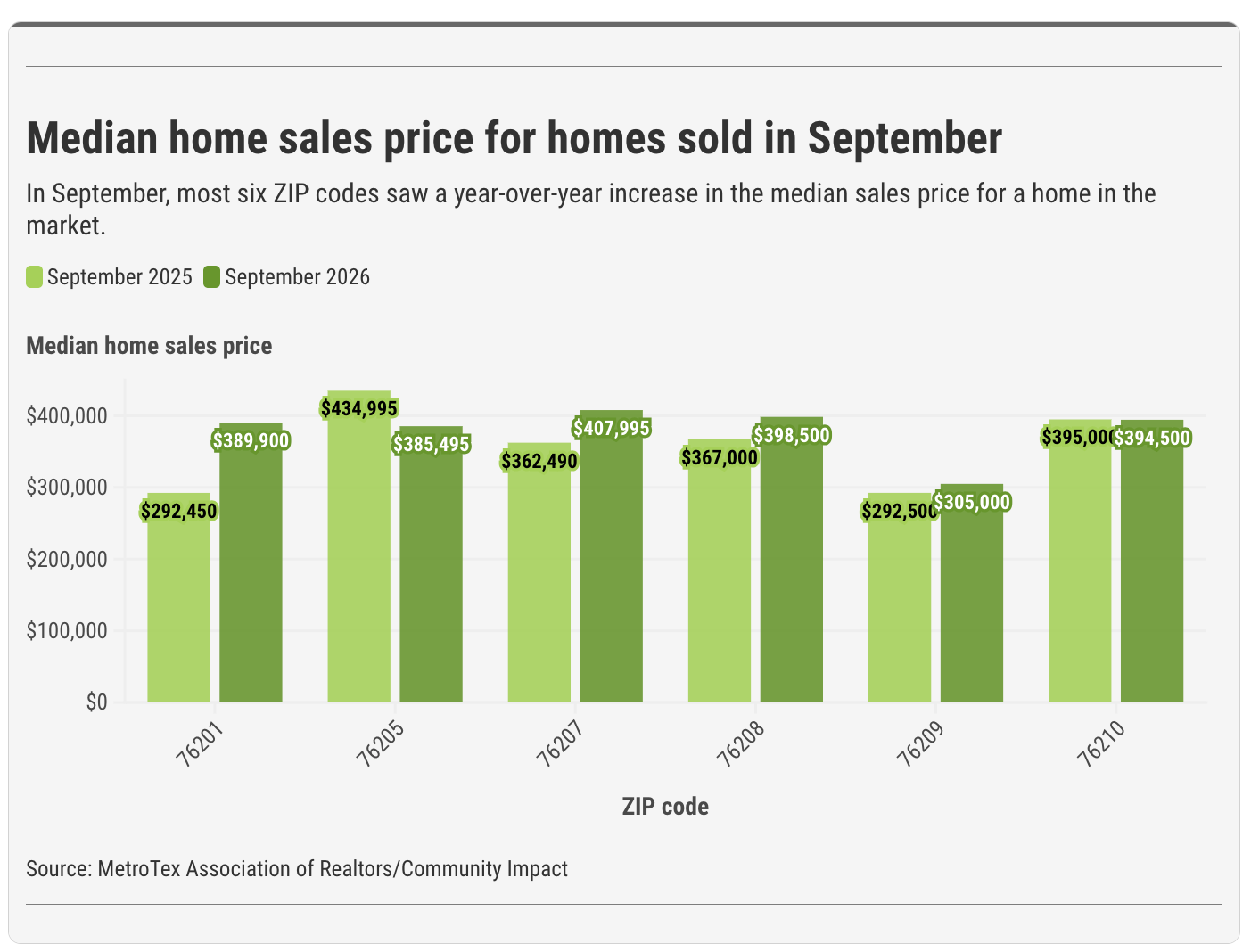
Four of Denton’s six ZIP codes experienced year-over-year increases in median home sale prices. The chart below reveals an interesting story.
In ZIP code 76201, the median sale price increased from $292,450 in September 2025 to $389,900 in September 2026. ZIP code 76207 also increased, from $362,490 to $407,995. Meanwhile, 76205 moved in the opposite direction, with its median sale price declining from $434,995 to $385,495.
These differences remind us that even within one city, there isn’t a single housing market.
Property type, location, condition, and the mix of homes sold during a particular month can all influence median prices. A year-over-year increase in one ZIP code doesn’t necessarily mean every property in that area appreciated by the same amount.
Some Denton Homes Are Taking Much Longer to Sell
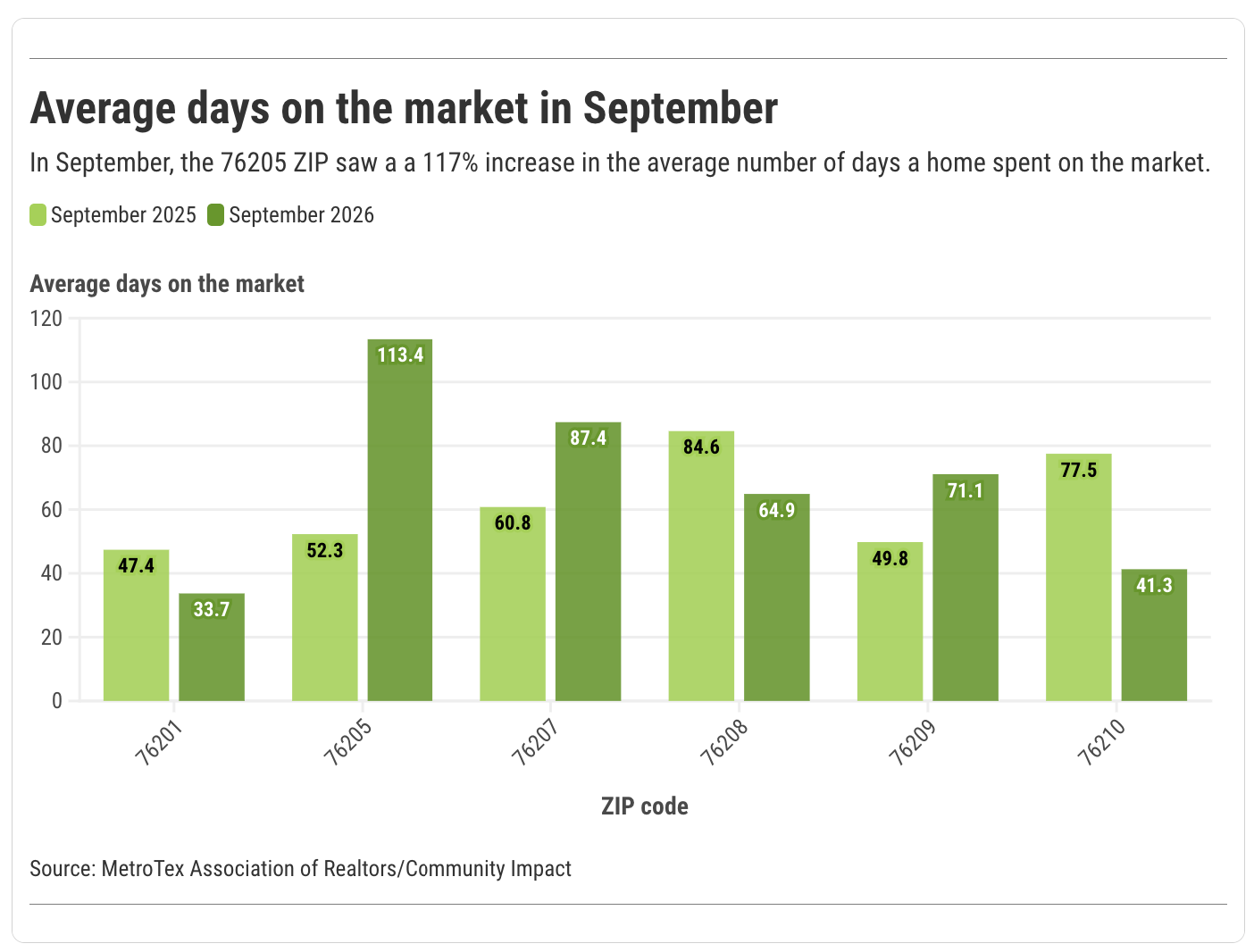
Days on market tell another part of the story.
In September 2026, homes in ZIP code 76205 spent an average of 113.4 days on the market, compared with 52.3 days in September 2025.
That’s an increase of approximately 117%.
The takeaway isn’t that Denton homes are universally taking longer to sell. It’s that buyers are responding differently depending on the property and its market position.
This mirrors the national picture: homes can still attract buyers, but sellers can’t assume the same level of demand across every price point or neighborhood.
What Does This Mean for Denton Rental Property Owners?
Although they're different, the for-sale market and the rental market heavily influence each other. When purchasing a home becomes more expensive, some households may choose to rent longer. Others may delay moving altogether, whether they currently own or rent.
But that doesn’t mean rental demand is unlimited or that owners can increase rents without considering the competition. Zillow’s Consumer Housing Trends Report 2027, based on nationwide renter research conducted in 2026, found that 94% of renters considered staying within their initial budget essential.
Among renters who had stayed in their homes for at least a year, 75% said a good deal on rent encouraged them to stay.
For rental property owners, those findings reinforce two important ideas.
1. Competitive Pricing Matters More Than Ever
A property isn’t priced correctly simply because a similar home rented for a certain amount last year.
Rental pricing needs to reflect current competition, the property’s condition, location, and what prospective residents can reasonably afford.
An ambitious asking price often leads to longer vacancies, which may cost more than a modest monthly rent adjustment.
The goal isn’t necessarily to charge the highest advertised rent in the neighborhood. It’s to achieve the strongest overall financial performance for the property.
2. Keeping Good Residents Has Real Value
Finding a new resident involves marketing, showings, screening, potential vacancy, and additional property preparation and maintenance.
When a reliable resident wants to renew, retaining that household can offer significant financial benefits.
That doesn’t mean avoiding appropriate rent adjustments. It means evaluating the full cost of turnover rather than focusing only on the potential monthly rent increase.
In a market where affordability is top of mind, thoughtful renewal pricing is vital to protecting an investment.
Should North Texas Homeowners Sell or Rent Their Property?
For some homeowners, selling may be the right decision, especially if they need access to equity or want to simplify their finances. For others, keeping the property as a rental may let them generate income while keeping ownership of a long-term asset.
The decision depends on several factors:
Current property value and available equity
Mortgage balance, interest rate, and carrying costs
Realistic rental income and expected expenses
Property condition and anticipated maintenance
Long-term investment goals
What’s important is making that decision using current information rather than assumptions about where the market was two or three years ago.
The Bigger Picture for Denton Property Owners
Denton has its own character, economy, neighborhoods, and housing needs. But we’re also part of a national market shaped by interest rates, consumer budgets, and changing expectations.
The lesson from 2026 isn’t that the market is simply good or bad- it’s that it's becoming more selective, and property owners need to be equally thoughtful.
As Denton property management experts at Pros PM, we believe successful property management starts with understanding both the broader market and what’s happening at the neighborhood level. That perspective helps us make better decisions about pricing, leasing, maintenance, and long-term property performance.
Because while real estate trends may be national, the decisions that matter most happen right here at home.
